Yet that simple reflex can quietly backfire.
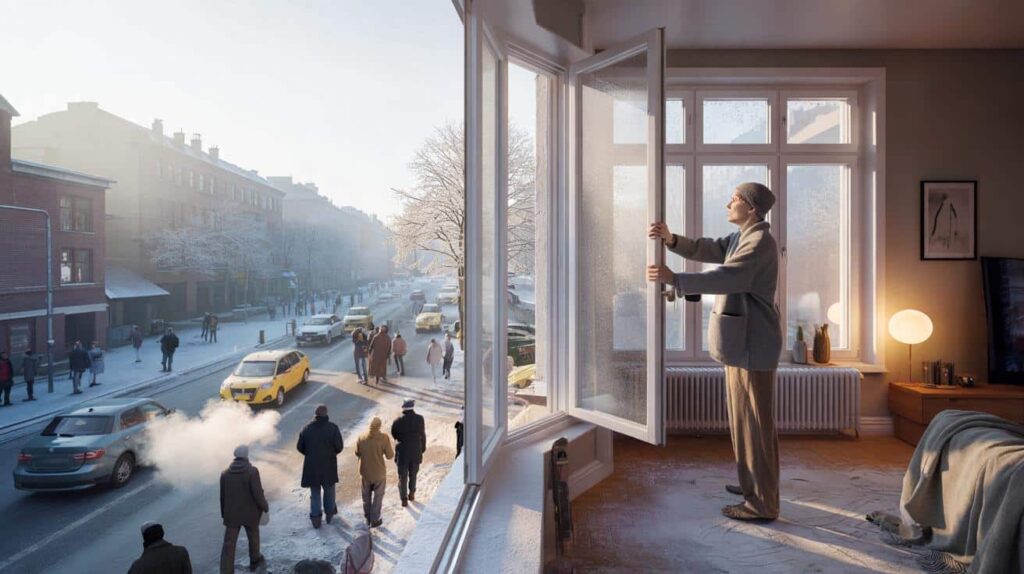
Across Europe and North America, energy experts and air‑quality researchers are now warning against flinging windows wide open during early winter rush hour. The air may feel crisp, but what slips indoors at that time is often colder, dirtier and more expensive than people realise.
Why winter airing matters more than you think
Indoor air builds up moisture, CO₂, tiny particles and chemical residues from cooking, cleaning and even furniture. In tightly insulated homes, this pollution can accumulate fast. Without some fresh air coming in every day, occupants can experience headaches, tiredness, irritated eyes and worsening asthma.

So yes, airing your home in winter still makes sense. The problem is not the act itself, but the timing. And, according to specialists, the 8–10 a.m. slot is one of the worst windows of the day.
Opening your windows at the wrong winter hour can mean more pollution, more heating costs and less comfort for the same gesture.
The morning pollution spike: what actually happens between 8 and 10 a.m.?
Those two hours coincide with peak human activity. Commuters hit the road, parents drive children to school, delivery vans multiply and heating systems crank up at the same time.
Traffic and heating create a dense pollution cocktail
In many towns and cities, measurements show clear spikes in nitrogen oxides, fine particles and black carbon between 7 and 10 a.m. Cold, often stagnant air traps these pollutants near the ground, exactly where you open your windows.
If you live near a busy road, a bus route or a junction, these peaks are even sharper. The exhaust from engines, combined with emissions from boilers and wood‑burning stoves, concentrates in residential streets.
When you air your flat during winter rush hour, you may swap slightly stale indoor air for a direct shot of roadside pollution.
Those fine particles can slip deep into the lungs and potentially affect the heart and blood vessels over time. For people with asthma, COPD or heart conditions, that 10‑minute airing at the wrong time can degrade air quality indoors for hours.
Even small towns are not spared
This is not just a big‑city problem. Smaller towns with narrow streets, valleys or frequent temperature inversions can trap pollution very effectively on cold mornings. In rural areas, domestic wood burning and older diesel vehicles can create their own morning peak.
The coldest hours of the day hit your heating bill
In winter, the hours just after sunrise are often the chilliest. Walls and roofs have radiated heat away all night, and the sun has not yet had time to warm surfaces or air layers.
Open your windows between 8 and 10 a.m., and you invite in the coldest air of the day. That icy mass does not only cool the room air. It also drags down the temperature of walls, floors and furniture, which act as thermal reserves.
Each airing at peak cold forces your heating to “catch up”, working harder and burning more energy for the same indoor comfort.
For homes with gas or oil boilers, this means higher fuel consumption. For electric heating or heat pumps, it can push consumption into expensive peak‑tariff periods, or cause the system to switch to inefficient electric backup.
The hidden impact on your boiler or heat pump
Frequent temperature drops mean your heating system has to cycle on and off more intensely. Over time, this repeated stress can shorten the lifespan of boilers and heat pumps. Components heat up, cool down, then heat up again, instead of running in a smoother, more stable regime.
In older or poorly insulated homes, a single long airing at the coldest time of day can take hours to recover, as walls and ceilings slowly warm back up.
Better times of day to air your home in winter
Experts in building energy efficiency tend to agree on one thing: choose the mildest part of the day when you can. That slot is usually around midday.
The ideal window for winter airing is often between 12 and 2 p.m., when outdoor temperatures are higher and traffic is calmer.

Late morning or early afternoon airing has three advantages:
- Outdoor air is slightly warmer, so indoor temperature falls less.
- Rush‑hour pollution has eased in many areas.
- Your heating system can stabilise again before evening temperatures drop.
Two short sessions of 5–10 minutes, rather than one long half‑hour airing, often work better. Short, sharp airing renews air without giving time for walls and furniture to cool too much.
Practical airing strategies room by room
Bedrooms
After a night’s sleep, bedrooms accumulate moisture and CO₂. Instead of throwing windows open at 8 a.m. in freezing air, delay airing if possible until late morning. If schedules are tight, a quick, intense airing right after getting up, with the door closed to the rest of the flat, is a reasonable compromise.
Kitchen and bathroom
These spaces produce the most steam and odours. Use extractor fans during and just after cooking or showering. Then, when outdoor conditions are milder, complete the job with a 5‑minute wide opening of the windows to flush out remaining humidity.
Living room and office space
For rooms you occupy most of the day, two short airings at better times – late morning and mid‑afternoon – reduce stuffiness without producing big temperature swings. Cross‑ventilation, where two opposite windows are opened at once, clears the room far faster than cracking one window open for an hour.
Mechanical ventilation: your quiet ally
Many newer homes now include mechanical ventilation systems, such as continuous extract units or full mechanical ventilation with heat recovery (MVHR). When properly maintained, these systems renew indoor air without the brutal heat losses caused by open windows.
A well‑tuned ventilation system can let you breathe fresher air all winter while keeping windows shut during the worst pollution peaks.
Filters still need to be checked and replaced on schedule, or they themselves can become a source of contamination. In older homes without such systems, simple window habits remain the main tool – but they can be refined.
Key do’s and don’ts for winter airing
| Action | Good idea? | Why |
|---|---|---|
| Open windows 5–10 minutes around midday | Yes | Combines less pollution with milder temperatures |
| Leave a window tilted open all day | No | Constant heat loss and cooling of walls, little extra benefit |
| Cross‑ventilate with two opposite windows briefly | Yes | Rapid air renewal with limited cooling of structure |
| Airing between 8 and 10 a.m. on very cold days | Prefer to avoid | Pollution peak plus maximum thermal loss |
What changes if you live in a very polluted or very cold area?
In cities regularly affected by winter smog, you may need to adapt further. Local air‑quality bulletins or smartphone apps show when particle levels surge. On those days, airing can be limited to the cleanest hours, even if that means shorter openings.
In extremely cold regions, where temperatures remain well below zero all day, the gap between 9 a.m. and midday might be smaller, but the logic stays the same: aim for the relative “least bad” moment, keep airing brief and favour cross‑ventilation.
A simple scenario: what happens in a typical flat
Imagine a small, well‑insulated flat heated to 20°C with electric radiators. Outside temperature is 0°C at 8 a.m. and rises to 4°C by 1 p.m.
If the occupant opens the living‑room window for 15 minutes at 8 a.m., indoor air in that room can drop to around 14–15°C. The radiators then run at full power to gain back those 5–6 degrees, forcing up consumption just as the grid is under morning pressure.
Shift the airing to 1 p.m., keep it to 7–8 minutes and add cross‑ventilation, and the room might only fall to 17–18°C. The radiators still work a bit harder, but the energy spike is much smaller for similar air renewal.
Extra tips: combining airing with other healthy habits
Small behaviours amplify the benefit of smart airing. Drying clothes on a rack indoors without ventilation, for instance, can overload air with moisture and encourage mould. Using a dehumidifier, or airing more intelligently right after drying, reduces that risk.
Houseplants contribute a pleasant feeling of freshness but do not replace true ventilation. Some can even increase humidity. They work best as a complement, not as a solution on their own.
Taken together, these adjustments can significantly cut heating costs, reduce exposure to outdoor pollution and keep homes more comfortable – all by avoiding those tempting but costly 8–10 a.m. winter airings.