Your brain whispers “fake” long before you can argue back with science, telescopes and years of engineering. The colours look painted, the scale feels wrong, and everything seems… flat. Like a poster, not a place.
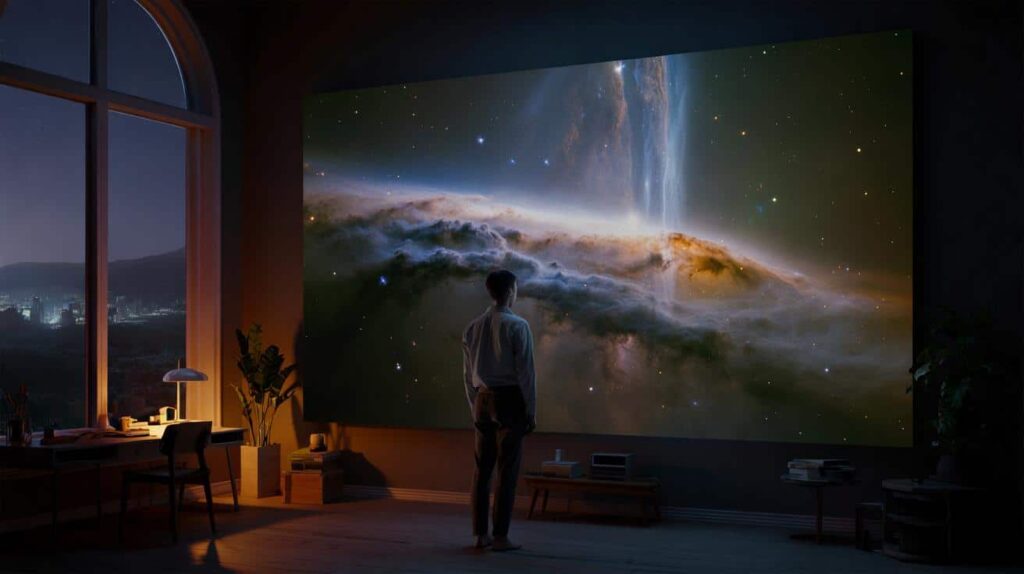
You zoom in on a galaxy and nothing gets sharper. You look for something familiar to latch onto – a horizon line, a tree, a cloud – and there’s just darkness and scattered light. It’s beautiful, but also slippery, hard to emotionally grab.
That uneasy feeling isn’t just you being picky or “too used to Instagram filters”. It’s your depth-hungry brain suddenly deprived of its favourite tools.

Why space looks fake to our very human eyes
On Earth, your eyes are spoiled. Every second, they swim in depth cues: shadows, perspective lines, textures fading into the distance. When you walk down a street, the pavement narrows, lamp posts shrink, colours wash out with haze. Your brain turns all of that into a rock-solid sense of “here” and “far away”.
Space images rip most of those cues away in one hit. There’s no air to create haze. No familiar objects to compare sizes. No ground or sky boundary to orient you. The result is almost too clean. Stars all look like they sit on a single sheet of black velvet, no matter how many light-years separate them.
That’s why your first reaction is so often: “This looks CGI.” Your visual system is doing its job, and it’s confused.
Photographers at major observatories talk about the same thing. When the first raw James Webb Space Telescope images landed in control rooms, some engineers reportedly blinked and laughed. The Carina Nebula looked like a film concept art board, not raw scientific data. Even seasoned astronomers double-took, because the usual lived-in messiness of Earth photos just wasn’t there.
Human eyes evolved for forests and faces, not for supernova remnants tens of thousands of light-years away. So people struggle with scale: that tiny bright smudge? It might be an entire galaxy, with hundreds of billions of stars. Our brains quietly refuse that number. They compress everything into something manageable, like a luminous sticker on a black wall.
Space agencies know this. That’s partly why they release side-by-side zooms, or animations that fly you “into” a nebula. Without motion or comparison, most of us just stare, appreciate the colours, and mentally file it next to desktop wallpapers rather than “this is a real place”.
Underneath the emotional reaction sits a stack of quite technical reasons. Human depth perception leans heavily on binocular vision – the tiny difference between what your left and right eyes see. That works brilliantly for objects within a few dozen metres.
For space, that stereo effect collapses. Whether a star is one or a hundred light-years away, the parallax between your two eyes is effectively zero. So your brain shifts to other clues: relative size, overlap, blur, atmospheric haze, known object dimensions. Space photography gives it almost none of those.
Even the incredibly sharp Hubble or Webb images are flattened by the medium they arrive in. A 3D universe is squeezed onto a 2D screen. Depth in space largely comes from time and motion. We observe how things move, explode, drift. A single frozen frame chops that story in half, and your brain hates incomplete stories.
How scientists “cheat” depth to make space feel real
Image teams have quietly learned to stage-manage our perception. One widely used trick is colour mapping. Many raw space images use wavelengths the eye can’t see – infrared, ultraviolet. Scientists translate those into visible colours, but they don’t just pick at random.
They’ll often give nearer dust clouds warmer tones and more distant structures cooler shades. Your brain already links warm colours with “closer” because sunsets and indoor lights behave that way. So, without spelling it out, they hand your perception a fake but helpful ladder of depth.
Contrast is another tool. By gently darkening some regions and lifting others, image processors can suggest layers, almost like a stage set. It doesn’t change the science in the data, but it seriously changes how “real” the scene feels.

Soyons honnêtes : personne ne lit les longues notes techniques qui expliquent ces choix de traitement tous les jours.
If you want to feel the space images more than just scroll past them, you can borrow a few of those tricks for yourself. Start by slowing down. Instead of taking in the whole image at once, pick one structure – a bright star, a pillar of gas – and follow everything connected to it.
Look for overlapping shapes. Where one cloud cuts in front of another, there’s your depth. Trace the tiny shadows in dust lanes. When a black streak breaks the light from behind, your brain suddenly knows which part is closer.
Then try swapping screen size. On a phone, everything looks decorative. On a big monitor or TV, your brain is more willing to treat it like a landscape. Step back a little, the way you would in a gallery. Let your eyes wander, rather than pinching and zooming aggressively.
People often rush straight to the colours and get stuck there. “It’s too saturated, it must be fake,” is a common comment under NASA posts. That reaction makes sense when your reference point is smartphone photos with auto HDR trying to flatter your lunch.
Another frequent trap: treating every bright dot as a star roughly the size of the Sun. Some of them are galaxies, some are foreground stars, some are cosmic rays hitting the detector. When you assume they’re all the same kind of object, your sense of depth collapses into a flat starfield wallpaper.
Try reading the caption before you decide how you feel about the image. Many agencies now write them in plain language, with little cues like “this region is bigger than our entire Solar System” or “those blue dots are young stars in the foreground”. It gives your brain a tiny legend, a way to start building a 3D picture instead of a pattern of dots.
“Space isn’t flat. Only our photos are.” a European Space Agency image specialist told me once, half joking, half exhausted after a long night shift. “We’re always trying to teach people to see the missing third dimension.”
There’s a quiet emotional layer to this, too. On a rough day, getting hit with the raw scale of a galaxy cluster can feel either soothing or crushing. One way to keep that experience gentle is to set yourself a tiny ritual.
- Glance at the scale: notice any numbers about light-years or parsecs.
- Pick one feature and mentally label it “foreground”.
- Find something obviously behind it and call it “background”.
- Pause for one slow breath while holding that 3D layout in mind.
*It takes maybe twenty seconds, but it can flip an image from abstract wallpaper to “oh, I’m actually looking into a volume, not at a surface”.*
Learning to live with the unreality of real space
Once you understand why your depth cues vanish in space, the weirdness softens. You stop expecting a galaxy to feel like a holiday snap, and you let it be something stranger. Something your eyes weren’t really built for, but your mind can still explore.
This isn’t just an astronomy problem. We’re entering an era where more and more of what we see – in VR, in games, in AI-generated images – tries to fake depth cues our brains rely on. Space photos sit at the opposite end of that spectrum: brutally honest data, with almost no concession to our instincts. Learning to read them is like a workout for perception.
On a screen, our universe will never quite shake that “too clean to be true” look. Yet the more you look, the more the flatness cracks. You begin to notice shapes stacked behind shapes, shells of gas layered like smoke, tiny clusters buried in the dark. Each time your brain manages to build a little 3D diorama from that 2D sheet of pixels, the image steps closer to feeling like a place, not a poster.
| Point clé | Détail | Intérêt pour le lecteur |
|---|---|---|
| Nos repères de profondeur disparaissent | Pas d’air, pas d’objets familiers, presque pas de parallaxe | Comprendre pourquoi les photos d’espace semblent “fausses” au premier regard |
| Les images sont activement retravaillées | Couleurs mappées, contrastes ajustés pour suggérer des couches | Voir ces images comme un mélange d’art et de science, pas comme une tromperie |
| On peut entraîner son regard | Repérer les recouvrements, lire les légendes, changer de format d’écran | Ressentir plus intensément les images spatiales et les partager avec plus de sens |
FAQ :
- Why do space photos look flat even though space is 3D?Because most of our usual depth cues vanish: your two eyes see almost the same thing, there’s no atmospheric haze, and we squash a 3D scene onto a 2D screen.
- Are the colours in NASA and ESA images “real”?They’re real in the sense that they come from genuine data, but often translated from invisible wavelengths into visible colours so we can see different structures and elements.
- Why do some stars look like they’re on a black curtain?Your brain has no size reference or motion to work with, so it mentally flattens everything onto a single surface, like glow-in-the-dark stickers on a ceiling.
- Can we ever see true depth in space images?Not with a single still image. Animations, 3D reconstructions and parallax from telescopes at different positions can give a stronger sense of volume.
- How can I make space pictures feel more “real” to me?Look for overlaps and shadows, read the scale in the caption, view them large, and imagine flying from a foreground feature to something far behind it.